The acronym Berg comes from Auf dem Berg and Silberberg, two neighboring hillside vineyards. This is a wine full of earthy stone fruit and a dry, crisp length that rises far above its "entry" class. The vineyard soils are a variation of France's famous argile-calcaire mix, or clay-limestone mix. . (Locally, Berg's soils are known as Muschelkalk, a geological term referring to the middle Triassic period, and in Berg's case it's Muschelkalk topsoil--averaging 3-feet--over limestone bedrock.) The clay gives Riesling body while the calcareous limestone gives finesse, focus, and length.
Riesling from limestone terroir differs from Riesling growing in Alsace’s granitic soils or pink sandstone (grès) soils by virtue of its structured ability (and need) to age. Unlike clay soils, granite and sandstone soils drain quickly, and its wine tends to be expressive right out of the gate. Or, as Mélanie once said, comparing Riesling from granite terroirs with Riesling from limestone: "Granite is always more explosive, very delicate, while limestone needs time to show its great potential and length."
The Pfisters farm six plots of Riesling to make the Berg cuvée, totaling 3.18 acres. Production averages 900 cases annually.

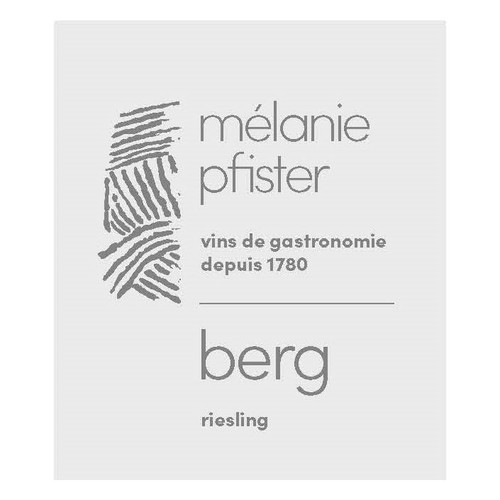
Mélanie Pfister Alsace Riesling Berg 2024 750ml
Mélanie Pfister
$37.99
Write a Review
Write a Review
Mélanie Pfister
Mélanie Pfister Alsace Riesling Berg 2024 750ml
- SKU:
- DB8284-24
- Minimum Purchase:
- 1 unit
- Shipping:
- Calculated at Checkout
- Subcategory:
- Riesling
- Country:
- France
- Region:
- Alsace
- Appellation:
- Alsace
- Vintage:
- 2024
- Features:
- Organic, Sustainable
- Raw Materials:
- Riesling
- Size:
- 750ml